# Video generation API costs by resolution, tier, and route
> Veo 3.1 per-second prices by tier and resolution, worked 8-second budgets, and the shutdown dates for the Gemini API, Vertex AI, OpenAI, and Azure routes.
- Published: 2026-10-13
- Last reviewed: 2026-10-13
- Data as of: 2026-10-13
- Article slug: ai-video-generation-models
- Author: [Glevd](https://x.com/glevd)
- Reading time: 8 minutes
- Topics: video-generation, api-pricing, veo, sora, gemini-api, model-retirement
- Data policy: Dated analysis; static benchmark claims are retained.
- Canonical URL: https://benchlm.ai/blog/posts/ai-video-generation-models
Google lists October 22, 2026 as the earliest shutdown date for all three Veo 3.1 preview models on the Gemini API, and names `gemini-omni-1.1-flash` as the replacement.
[OpenAI's Videos API](/deprecations/openai) and Sora 2 snapshots carry a September 24 shutdown date, and the last Sora 2 version on [Azure](/deprecations/azure) lists October 15.
If you're pricing a video generation API, check the route table below before you commit to a rate. We re-read each provider page on October 13, and we made no calls to any endpoint.
## Veo 3.1 rates run from $0.05 to $0.60 per generated second
**Evidence: [Google's Gemini API pricing page](https://ai.google.dev/gemini-api/docs/pricing), read October 13, 2026. Rows come from our video-price registry, last read 2026-10-13, and each carries its unit on the [Veo price page](/media-pricing/veo).**
| Model | Resolution | Price per second | Read date |
| --- | --- | --- | --- |
| Veo 3.1 | 720p | $0.40 per second | 2026-10-13 |
| Veo 3.1 | 1080p | $0.40 per second | 2026-10-13 |
| Veo 3.1 | 4k | $0.60 per second | 2026-10-13 |
| Veo 3.1 Fast | fast · 720p | $0.10 per second | 2026-10-13 |
| Veo 3.1 Fast | fast · 1080p | $0.12 per second | 2026-10-13 |
| Veo 3.1 Fast | fast · 4k | $0.30 per second | 2026-10-13 |
| Veo 3.1 Lite | lite · 720p | $0.05 per second | 2026-10-13 |
| Veo 3.1 Lite | lite · 1080p | $0.08 per second | 2026-10-13 |
Google bills Veo 3.1 by the second of video generated, and the rate includes audio. Lite is the cheapest row at 720p, and Standard at 4K is the dearest. Lite has no 4K row because Google doesn't offer 4K on it. Standard costs $0.40 at both 720p and 1080p, so the upgrade to 1080p is free on that tier and the jump comes at 4K. Fast and Lite step up at every resolution.
Google lists no free tier for these models. It says you're charged only for a video that generates successfully, and the Veo documentation says a video blocked by safety filters isn't charged. Plan to pay for a clip that generates and then fails your own review, because it's still a generated clip, and check the first invoice.
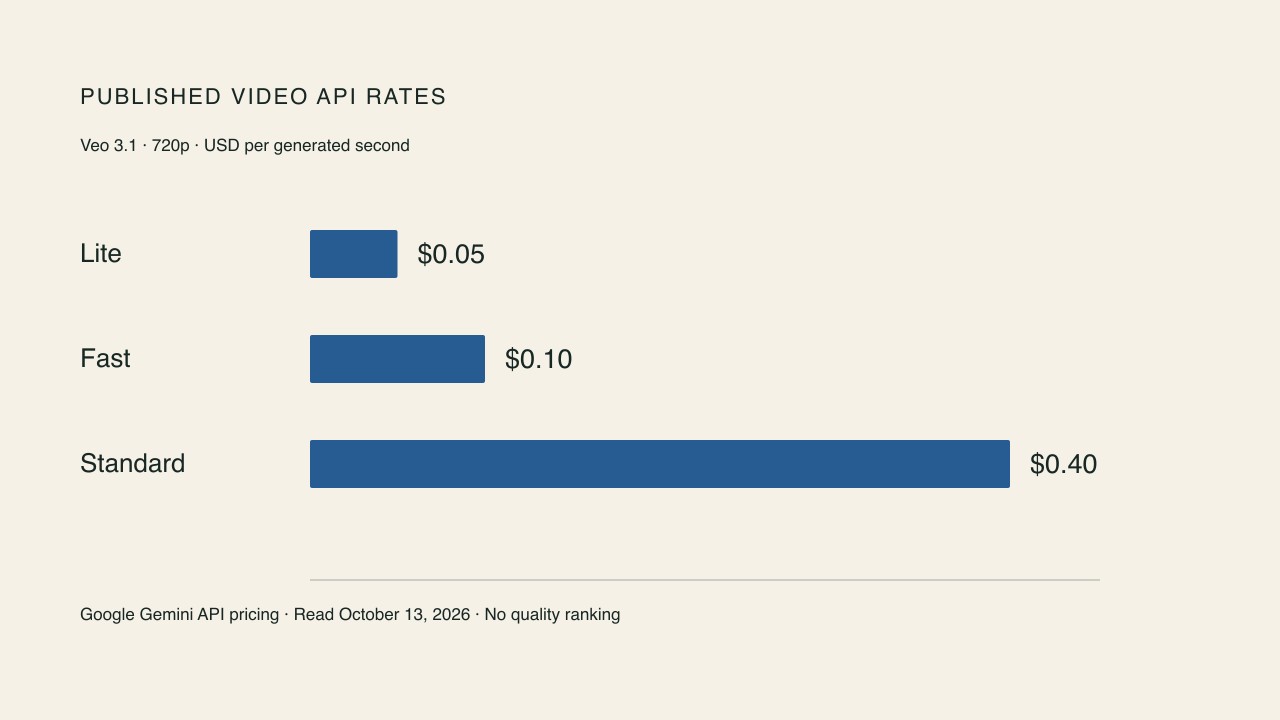
Published Veo 3.1 rates at 720p, in US dollars per generated second. These rates do not measure video quality.
## Eight-second clips set the floor at 1080p and 4K
Veo 3.1 makes one clip per request, 4, 6, or 8 seconds long. [Google's Veo documentation](https://ai.google.dev/gemini-api/docs/veo) says 1080p and 4K work only at 8 seconds, so those resolutions cost at least eight seconds of the rate. At 720p you can ask for 4 or 6 seconds and pay proportionally less.
| Resolution | Lite | Fast | Standard |
| --- | --- | --- | --- |
| 720p | $0.40 | $0.80 | $3.20 |
| 1080p | $0.64 | $0.96 | $3.20 |
| 4K | not offered | $2.40 | $4.80 |
These figures are the published per-second rates multiplied by eight. They're unit-price arithmetic, not a tested clip, an acceptance rate, or an all-in bill.
Take a hypothetical job: ten accepted clips of 8 seconds each at 720p, which is 80 seconds of footage. If every attempt is accepted, the output charge is $4.00 on Lite, $8.00 on Fast, and $32.00 on Standard. If it takes three attempts for each clip you keep, those become $12.00, $24.00, and $96.00. Three attempts is a placeholder, not something we measured.
Acceptance rate can flip the ranking. Per accepted clip, a cheaper tier stays cheaper as long as its acceptance rate is above the price ratio below times the dearer tier's rate.
| Cheaper tier vs dearer tier | 720p | 1080p | 4K |
| --- | --- | --- | --- |
| Fast vs Standard | 0.25 | 0.30 | 0.50 |
| Lite vs Fast | 0.50 | 0.67 | not offered |
| Lite vs Standard | 0.13 | 0.20 | not offered |
At 720p, for example, Fast beats Standard on cost per accepted clip unless fewer than a quarter as many Fast clips pass your review. If 60 percent of Standard clips would pass, Fast has to pass more than 15 percent to break even. Both pass rates are made up for the example.
What the tables leave out is the part you have to measure: how many attempts each tier needs for your prompts, what counts as accepted, and whether your invoice agrees with seconds times rate.
## Each route has its own model IDs and its own date
**Evidence: [Google's deprecations page](https://ai.google.dev/gemini-api/docs/deprecations), [Google Cloud's Vertex AI model versions](https://docs.cloud.google.com/vertex-ai/generative-ai/docs/learn/model-versions), [OpenAI's deprecations page](https://developers.openai.com/api/docs/deprecations), and [Microsoft's retirement schedule](https://raw.githubusercontent.com/MicrosoftDocs/azure-ai-docs/main/articles/foundry/openai/includes/concepts-model-retirement-schedule-content.md), all read October 13, 2026, plus our lifecycle feed captured that day.**
| Model IDs | Route | Published date | What the date means | Named replacement |
| --- | --- | --- | --- | --- |
| `veo-3.1-generate-preview`
,
`veo-3.1-fast-generate-preview`
,
`veo-3.1-lite-generate-preview` | Gemini API | October 22, 2026 | Earliest possible shutdown; exact date announced with notice | `gemini-omni-1.1-flash` |
| `veo-3.1-generate-001`
,
`veo-3.1-fast-generate-001` | Vertex AI | None announced | Google Cloud lists "No retirement date announced"; both IDs were released November 17, 2025 | None named |
| `sora-2`
,
`sora-2-pro`
, and their dated snapshots | OpenAI Videos API | September 24, 2026 | Shutdown date, listed under past deprecations | None listed |
| `sora-2`
version 2025-12-08 | Azure AI Foundry | October 15, 2026 | Retirement date of a preview version | None listed |
| `sora-2`
version 2025-10-06 | Azure AI Foundry | July 15, 2026 | Retirement date of a preview version | `sora-2`
version 2025-12-08 |
| `gemini-omni-1.1-flash` | Gemini API | None announced | Generally available on the paid tier | Not applicable |
Gemini API and Vertex AI are separate routes for the same model family, with different IDs and different dates. Prices above come from the Gemini API pricing page, so they price the `-preview` IDs in the first row. We haven't tabulated Vertex AI prices, so don't read the table as a Vertex rate. Beyond these Google, OpenAI, and Azure rows, we price no other vendor, so this isn't a census of AI video generation models.
Each Google date is an earliest possible date, not a scheduled day. [Google's deprecations page](https://ai.google.dev/gemini-api/docs/deprecations) says it will communicate the exact shutdown date with advance notice, so October 22 means "not before" rather than "on". Our [Google deprecation page](/deprecations/google) keeps the receipt for each row, and [what deprecated means](/blog/posts/what-deprecated-means) covers how providers use the word.
OpenAI is the other kind of record. Its deprecations page lists the Videos API and the Sora 2 snapshots under past deprecations, with September 24, 2026 as the shutdown date and no replacement. Our registry still holds [Sora 2 rows](/media-pricing/sora) dated September 11. Treat them as historical billing evidence for reading an old invoice, not as an offer you can order from. Every date in this section is a provider's published date. None is an outage we observed.
## Google's named replacement bills tokens, not seconds
`gemini-omni-1.1-flash` is the model Google names in place of all three Veo 3.1 previews. Google's deprecations page lists its release as August 27, 2026 and shows no shutdown date, and the pricing page describes it as generally available on the paid tier. Its preview sibling, `gemini-omni-flash-preview`, carries the same October 22 date as the Veo previews, so a config that points at the preview ID has the same problem.
Omni Flash uses a different unit. Per [Google's pricing page](https://ai.google.dev/gemini-api/docs/pricing), Omni Flash video output is priced at $17.50 per million tokens and says 720p video uses 5,792 tokens per second, which works out to about $0.10 a second. Eight seconds is 46,336 tokens, or about $0.81, against $0.80 for the same length on Veo 3.1 Fast at 720p. Prompts and any media you send in are billed separately, at $1.50 per million tokens.
Two limits apply. Google's footnote converts 720p only, and we found no token rate for 1080p or 4K in the pricing text, so we haven't priced those. And Google describes Omni Flash as a video generation and editing model, so a named replacement isn't a promise that your Veo prompts, durations, or outputs carry over. Run your own clip before you move.
## Resolution, audio, and route narrow the choice before price does
Work through these in order, because the first one can rule out an option before you look at a rate.
1. **Check the route your code calls.**
A Gemini API
`-preview`
ID has an October 22 earliest date, so a new build should target
`gemini-omni-1.1-flash`
or Vertex AI's
`-001`
IDs, which have no announced retirement date. Sora on OpenAI is past its date, and Azure's last Sora 2 version lists October 15 with no replacement, so neither is a base for new work.
2. **Set the resolution.**
4K means Veo 3.1 Fast or Standard, at eight seconds. 1080p adds Lite, also at eight seconds. At 720p all three tiers accept 4, 6, or 8 seconds.
3. **Decide about audio.**
Veo 3.1 generates audio on every request and Google's rows are priced with it. We found no cheaper silent option.
4. **Pick the tier by cost per accepted clip,**
using the break-even table. Lite is the wrong choice if you need 4K, clip extension, or reference images, which Google's docs don't list for it. Standard is the wrong choice at 720p unless Fast passes less than a quarter as often. Fast is the wrong choice at 1080p if Lite passes more than two-thirds as often.
## Check five things before you pay
1. **Match the model string.**
Copy the ID from the row for your route, including
`-preview`
or
`-001`
, and re-read Google's deprecations page the day you ship.
2. **Confirm the duration for your resolution**
in
[Google's Veo docs](https://ai.google.dev/gemini-api/docs/veo)
. We read 4, 6, and 8 seconds on October 13, and preview-model limits can change.
3. **Run one clip per tier**
with the prompt, resolution, duration, and audio setting fixed. Record attempts, blocked requests, accepted clips, and the billed amount. Our
[workload worksheet](/blog/posts/building-custom-llm-benchmark)
shows the same accounting for text tasks.
4. **Reconcile the first invoice line**
against seconds times rate. If it doesn't match, you've found a billing unit you hadn't priced.
5. **Plan for retrieval and latency.**
Google's docs say generated videos are kept for 2 days, so download them, and give a latency range from about 11 seconds to 6 minutes at peak.
Two dates to watch: October 15 for Azure's Sora 2 version and October 22 for the Gemini API Veo previews. Vertex AI's Veo IDs have none announced yet. Price tables that don't carry their shutdown dates keep quoting a row after the model behind it is withdrawn, so [follow model changes](/radar) if you'd rather be told than check. For text models, our [token price tables](/llm-pricing) keep rates in a different unit.
*Sources: Google's Gemini API pricing, Veo, and deprecations pages and Google Cloud's Vertex AI model versions page, read October 13, 2026; OpenAI's deprecations page, read October 13, 2026; Microsoft's Azure OpenAI retirement schedule, read October 13, 2026. Our [media-pricing hub](/media-pricing) keeps the registry rows with their units.*
## Frequently asked questions
### How much does an 8-second Veo 3.1 clip cost?
At the published rates, an 8-second 720p clip costs $0.40 on Veo 3.1 Lite, $0.80 on Fast, and $3.20 on Standard. That is output arithmetic from rates read October 13, 2026. It excludes rejected attempts and assumes your model ID is still callable on your route.
### Is the Sora API still available?
OpenAI lists September 24, 2026 as the shutdown date for the Videos API and Sora 2, with no replacement. Azure's last Sora 2 version lists October 15, 2026. We have not called either endpoint, so this reports published dates, not a status check. Consumer Sora plans are outside this article.
### Will my Veo 3.1 model ID work after October 22?
Google calls October 22, 2026 the earliest possible shutdown date for the three Gemini API preview IDs and promises advance notice of the exact date. These IDs may keep working past it, but Google doesn't commit to that. Vertex AI's -001 IDs have no announced retirement date.
### Is there a free tier for video generation in the Gemini API?
Google's pricing page lists the free tier as not available for Veo 3.1 as of October 13, 2026, and the same for Gemini Omni Flash. Veo requests are billed per generated second, so test runs cost money too. Consumer apps and subscription plans are separate products.