Moonshot launched Kimi K3 on July 16, 2026 and published the weights on July 27. K3 has 2.8 trillion total parameters, 104 billion active, native vision, and a 1,048,576-token context. The official API is $3.00 per million cache-miss input tokens, $0.30 cache-hit, and $15.00 output. The shards are public. Most users will still rent it.
The rental constraint is the product, not a caveat.
The July weights note recorded the drop. This piece covers the decision it created. The Kimi K3 model profile holds live scores and evidence; the Kimi API pricing hub holds rates.
The shards are open. Serving is not.
Open, for K3, means three concrete things.
You can download 96 Safetensors shards from Moonshot’s Hugging Face repository. You can read the technical report. You can, in principle, serve the model through the stacks Moonshot lists: vLLM, SGLang, and TokenSpeed.
It does not mean a 30-billion-parameter weekend project. Moonshot recommends supernode configurations with at least 64 accelerators because expert routing and communication are part of the serving problem at this scale. Open does not mean small.
It also does not mean a blank check. The Kimi K3 License lets most teams fine-tune and run the model internally. Two clauses change the story for anyone who wants to sell it. A model-as-a-service business whose licensee-and-affiliate revenue exceeds $20 million over any consecutive twelve months must enter a separate agreement with Moonshot before commercial use. Products above 100 million monthly active users, or $20 million in monthly revenue, pick up an attribution obligation. Internal use is the exempt path. Resale is the gated one.
The license is a distribution strategy wearing open weights. Public shards let researchers, fine-tuners, and small hosts move. Amazon, a GPU neocloud, or anyone else with a real inference business has to come back to the table.
The score is a shortlist, not a deployment plan
The 18 August public BenchAlign projection scores K3 at 80.5 Supported. Claude Fable 5 is 83.0 and Claude Mythos 5 is 83.2 on the same projection. K3 has a serious open-weight position, not a closed-frontier knockout.
Moonshot’s own launch post says K3 still trails the strongest proprietary systems. We are going to keep that sentence. Its provider table mixes official leaderboards, Moonshot runs, and several agent harnesses. K3 often runs through Kimi Code. Comparison rows can use Claude Code, Codex, or another published setup. Reasoning effort is set to max. Exact numbers can still compare more than one experiment.
Artificial Analysis’s public K3 (max) row is useful as a third-party cut, not as our rank. Its Intelligence Index is 59.70, coding is 76.24, and agentic is 54.26. AA-Briefcase puts K3 at 1541 Elo, behind Fable 5 at 1574, and records nearly an hour per task. The hour belongs next to the score. A model can be frontier-adjacent and still be the wrong default for work that has to finish before lunch.
We keep those distinctions on the live profile. Provider-exact rows, native rows, display-only evidence, and ranking-eligible inputs do not collapse into one “K3 beats Sol” headline. A useful next result needs a matching model, effort, harness, hardware, and task version.
Only the API is ordinary
There are now three ways to use the family. Only two of them are decisions a normal team can actually make.
| Path | Price (in / out per 1M) | Context | Use it when | Where it loses |
|---|---|---|---|---|
| Kimi K3 API | $3.00 / $15.00 ($0.30 cache-hit) | 1,048,576 | You want the current ceiling and the 1M window without operating inference | Output is expensive, and K3 is not on the discounted Batch API |
| Kimi K2.7 Code or K2.6 | $0.95 / $4.00 | 256K | Coding cost or a smaller context is the real constraint | Neither is the flagship. Coverage and ceiling differ. |
| Self-host K3 | Cluster invoice, not a token invoice | 1,048,576 | Custody, modification, or sustained volume justifies 64+ accelerators and the license works for your revenue | This is an infrastructure project. For most teams it is a fantasy with a Hugging Face URL. |
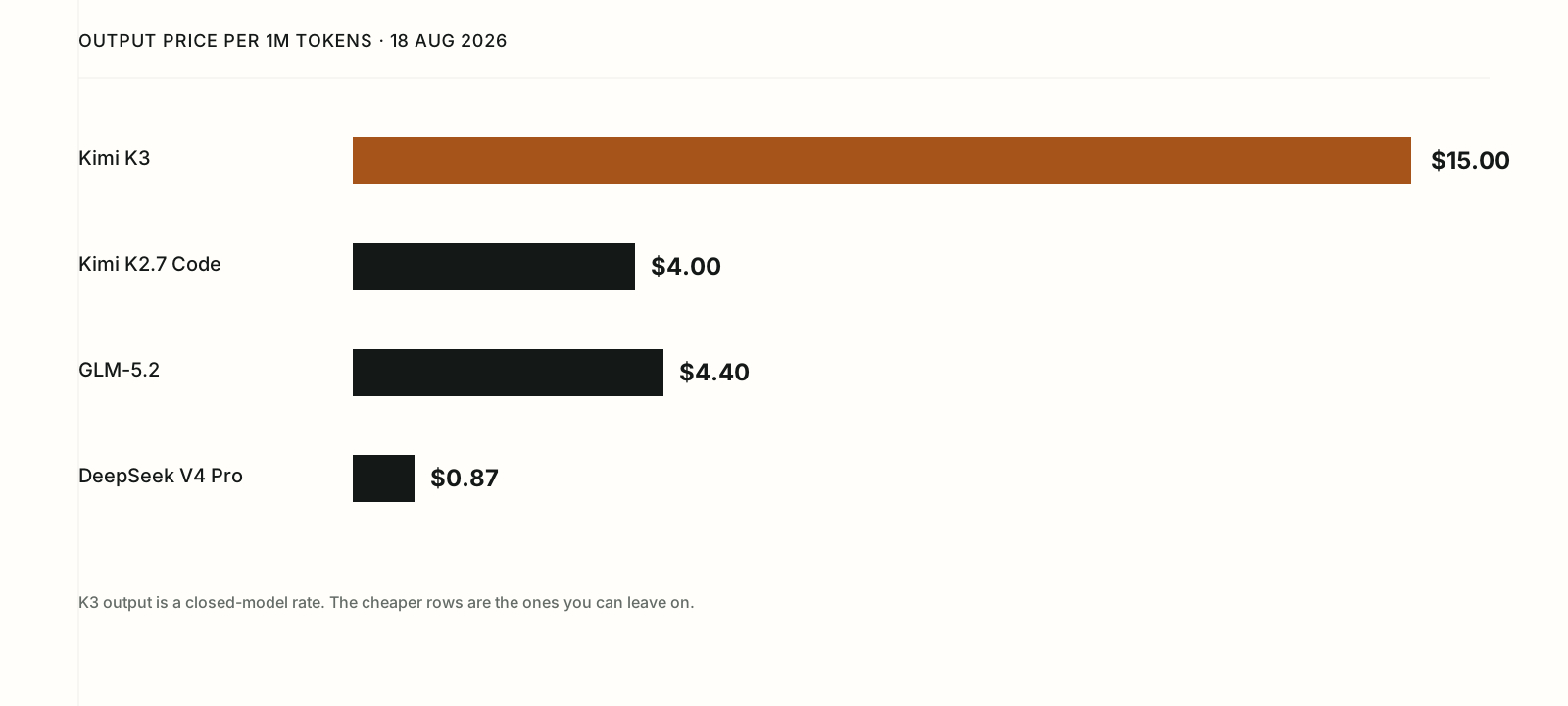
K3 output is a closed-model rate. The cheaper rows are the ones you can leave on.
DeepSeek V4 Pro is the deployable cost bet, not a Kimi sibling. Its official pricing table lists DeepSeek V4 Pro at $1.32 / $3.96 per million input/output tokens at peak, and half that off-peak. DeepSeek V4 Pro’s cache-hit input rate is $0.044 per million tokens at peak. Those rates took effect at 16:00 UTC on August 16, 2026. GLM-5.2 is $1.40 / $4.40 with a 1M context window and the higher open-weight coding row in the current snapshot. Those are the models you cross-shop if “open and cheap enough to leave on” is the job. K3 is what you call when the last points are the job and you will pay closed-model output rates to get them.
Start at the pricing owner, then the Chinese-model ranking or a direct comparison. If self-hosting is the reason you opened this tab, put the workload in the self-host calculator before treating $15 output as the expensive option. GPUs have invoices too. They merely arrive under different nouns.
Most teams should rent the endpoint
For almost everyone, the official Kimi API is the run. Model ID kimi-k3. Text and image in, text out. Flat rate across the full window. No Batch SKU to hide inside.
Third-party hosts exist. Treat each one as unverified until you have a dated endpoint row: who is serving, which checkpoint, which quantization, which region, which price. An OpenRouter card with a null latency field is a listing, not a measurement.
If you are actually going to serve the weights, Moonshot’s listed paths are vLLM, SGLang, and TokenSpeed, with MXFP4 weights and MXFP8 activations. The serving stack is an implementation receipt, not a hardware plan. Count accelerators, interconnect, and the license before you count tokens.
We have not stood up a 64-accelerator K3 cluster for this article. We are not going to write the paragraph that pretends we did.
A reproduced run would change the decision
K3 ended the era where “open” meant “almost as good, much cheaper, you can host it.” At 2.8T, with a supernode recommendation and a resale clause that pulls any serious inference business back to Moonshot, the flagship is a frontier API that happens to publish shards.
Watch for a reproduced coding or agentic run at a named effort and harness, or a host that serves K3 below $15 output on a real workload. Until one lands, rent the model. Do not romanticize the download.
Frequently asked questions
01What is Kimi K3?
Kimi K3 is Moonshot AI’s flagship, launched July 16, 2026, with full weights on July 27. It is a 2.8-trillion-parameter Mixture-of-Experts model with 104 billion active parameters, native vision, and a 1,048,576-token context window. The practical path for most teams is the official API, not a workstation download.
02Is Kimi K3 the best open model?
Kimi K3 is the strongest open-weight row in the 18 August public BenchAlign projection at 80.5 Supported. Claude Fable 5 is 83.0 and Claude Mythos 5 is 83.2 on the same scale. Moonshot’s launch post also says K3 trails the strongest proprietary systems. Check the live model profile as those rows move.
03How much does the Kimi K3 API cost?
Moonshot lists Kimi K3 at $3.00 per million cache-miss input tokens, $0.30 per million cache-hit input tokens, and $15.00 per million output tokens. The rate is flat across the full 1,048,576-token window. K3 is not listed on Moonshot’s discounted Batch API.
04Can I run Kimi K3 locally?
You can download the shards. You almost certainly cannot serve them on a workstation. Moonshot recommends supernode setups with at least 64 accelerators. The Kimi K3 License also requires a separate agreement before a model-as-a-service business above $20 million trailing revenue can resell it.
05Kimi K3 vs DeepSeek V4 vs GLM-5?
Call K3 when you want the open-weight ceiling and will pay $3/$15 for it. Call DeepSeek V4 Pro when deployable cost matters more than the last points. Call GLM-5.2 or Kimi K2.7 Code when coding cost and a smaller footprint beat the flagship. None of those is a universal winner.
06What happened to Kimi K2.6?
K2.6 remains a cheaper, smaller API at $0.95/$4.00 with a 256K context window. It is not the current flagship. K2.7 Code is the coding specialist in the same family. The July weights note covers the K3 drop; this article covers the deployment decision that followed.
External sources linked in this article
5- 01Kimi K3kimi.com
- 02Moonshot’s Hugging Face repositoryhuggingface.co
- 03technical reportgithub.com
- 04Kimi K3 Licensehuggingface.co
- 05official pricing tableapi-docs.deepseek.com