ChatGPT Enterprise has no list price. OpenAI's pricing page says "Custom pricing" and sends you to sales.
One part of the bill is public, though. OpenAI publishes the rate at which Enterprise usage burns credits, model by model.
We set that rate table against OpenAI's API prices on November 23, 2026. Every rate lands on the same number: 25 credits for each dollar of API list price.
So a credit stands for four cents of API usage. That gives you one number to ask sales for, and a way to tell whether the quote is good.
ChatGPT Business has two published prices and Enterprise has none
OpenAI's business pricing page has two plans. Business is self-serve and priced. Enterprise is not.
A Standard Business seat is $25 a user a month, or $20 billed yearly. A Premium seat is $125, or $100 billed yearly, and OpenAI describes it as "More usage than standard, with no 5-hour limit."
Enterprise says "Custom pricing." The page gives no seat price, no minimum, and no contract length.
Business covers "teams of 2–200 employees," and a workspace can mix the two seat types. It also carries up to $500 a month in API credits for the workspace, a benefit OpenAI says it may change or end.
For Enterprise, the page lists what you get and nothing about what it costs: a larger context window, security controls, data residency, "24/7 priority support, SLAs, custom legal terms," and "Invoicing and billing, volume discounts."
One footnote matters more than the rest. It says credit-based pricing and token-based pricing are both available for Enterprise plans. That is the meter.
Every credit rate is four cents of API list price
OpenAI's pricing documentation for ChatGPT Work and Codex has a table of credit rates. It gives credits per million input tokens, cached input tokens, and output tokens for each model.
We lined up ten of those models with the API prices in our pricing data. That's 30 rates. All 30 come out at exactly 25 credits per dollar.
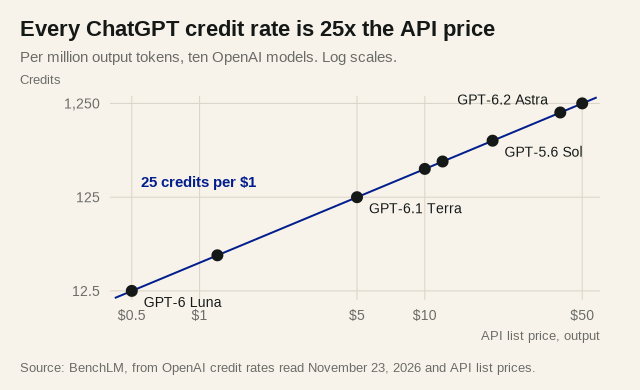
GPT-6.2 Astra costs $40 per million output tokens on the API and 1,000 credits in ChatGPT. GPT-6 Luna costs $0.50 and 12.5 credits. GPT-5.6 Terra costs $12 and 300 credits. Divide any pair and you get four cents a credit.
We call this the four-cent credit. A credit is API usage under another name.
OpenAI's documentation explains why the rates can be public while the price isn't. "Credit purchase prices and applicable discounts depend on your plan or agreement." The rate card is fixed and published. Your discount lives in the price of a credit, and that sits in your contract.
That turns a vague negotiation into arithmetic. If your quote prices a credit below four cents, agent work inside ChatGPT Enterprise at standard speed costs less than the same tokens through the API. If it prices a credit above four cents, you're paying a premium for the workspace. This reading is ours. OpenAI doesn't describe credits this way.
Without flexible pricing, an Enterprise seat has Plus limits
Enterprise comes in more than one billing shape, and the shape decides what a seat can do.
OpenAI's documentation describes two. On flexible pricing, "Enterprise/Edu users with flexible pricing have no fixed rate limits. Usage scales with credits." Without it, "Enterprise and Edu plans without flexible pricing have the same per-seat usage limits as Plus for most features."
So an Enterprise seat on a fixed plan gets the agent allowance of a $20 Plus subscription. The security controls are what set it apart.
On flexible pricing, the seat is an entry fee and the work is metered. Our Bug Hunt Bench rows show what metered work costs. A Codex run with GPT-6.2 Astra at max reasoning took 122 minutes and $28.35 at list rates in the November 20 snapshot. At 25 credits a dollar, that's about 709 credits for one long coding task. The same run with GPT-6.2 Sol cost $7.00, or 175 credits.
Speed costs extra, and it moves the break-even. Fast mode doubles the credit rate, so a credit has to cost under two cents to beat the standard API list price there. Ultrafast on GPT-6.2 Astra and GPT-6.2 Sol costs three times the standard rate through February 28, 2027, and six times from March 1.
OpenAI also notes that some Enterprise customers are still on a legacy rate card, and that agreements billed in dollars use a separate Enterprise rate card. Ask which one your quote uses.
Enterprise and Business have the same models
OpenAI's comparison table has 84 rows. Business and Enterprise differ on 21 of them. None of the 21 is a model.
Both plans list the same nine current models, from GPT-6.1 Sol to GPT-5 Thinking Mini, with the same "Flexible" access. Both get ChatGPT Work, Codex, deep research, and workspace agents. Neither trains on your data by default.
Most of the 21 rows are identity and control: SCIM, role-based access, granular GPT controls, IP allowlisting, a global admin console, a connector registry. Compliance takes the next group, with enterprise key management, the Compliance API, ISO 27001 certification, and data residency in ten regions.
A few rows are product. Instant answers get a 128K context window against 54K on Business, while reasoning models get 256K on both. Response times are listed as "Fastest" against "Fast." What remains is people: enhanced support, dedicated onboarding, account management, and a custom security review.
The 200-person ceiling on Business is the other gate. Past it, Enterprise is the only plan OpenAI offers. Our Business AI plans page keeps the seat prices and terms for ChatGPT, Claude, Copilot, and Perplexity side by side.
The $60 seat figure traces to one 2023 post
Search for the price and you'll get a number anyway. On November 23, Google's AI Overview for "chatgpt enterprise pricing" said procurement reports cite about $60 a user a month, in a $45 to $75 range, with a 150-seat minimum.
We read the pages behind that answer. None names a buyer, a dataset, or a dated quote.
- Composio's guide credits the $60 average to CloudZero, which credits an unnamed licensing advisory. Composio adds that OpenAI has not confirmed the figures.
- Coworker's guide says the $60 figure "traces back to a single 2023 Reddit post" and that no fresh 2026 quote has surfaced publicly. Coworker sells a competing product, and we could not open the Reddit post to check its account.
- Dan Cumberland Labs gives $60 to $100 in one place and "roughly $60" in another, and cites eesel AI for both.
The $108,000 a year that several guides call the entry point is their own multiplication: 150 seats times $60 times 12 months.
The figure may be right for someone. But three years is a long time for a quote, and the product it described has changed. In 2023 there were no credits, no Premium seats, and no ChatGPT Work. Treat $60 as a rumor with an old source.
Ask sales for three numbers
OpenAI publishes the rate card. The rest is in your quote. Get these in writing before you compare it with anything.
- The price of a credit. Below four cents beats the API at standard speed. Above it, you're paying for the workspace.
- The billing shape. Flexible pricing, a fixed plan with Plus-level limits, or a dollar rate card. Each one produces a different bill for the same team.
- The minimums. Seats, contract length, and any committed credit spend. OpenAI states none of them publicly.
Then check whether you need Enterprise at all. If you have 200 people or fewer and don't need SCIM, your own encryption keys, or data residency, Business gives you the same models at a published price.
Frequently asked questions
01How much does ChatGPT Enterprise cost?
OpenAI doesn't publish a price. Its pricing page lists ChatGPT Enterprise as custom pricing and sends buyers to sales, as of November 23, 2026. Third-party guides repeat about $60 a user a month, and the one guide that names an origin traces that figure to a single 2023 Reddit post. The public parts are the ChatGPT Business seat prices and the credit rates.
02Is there a minimum number of seats for ChatGPT Enterprise?
OpenAI doesn't state one. Its pricing FAQ says Business plans start at 2 users and tells Enterprise buyers to contact sales. The 150-seat minimum that many guides repeat has no named source in any guide we read on November 23, 2026. Ask sales for the minimum in writing before you plan a budget around it.
03What is the difference between ChatGPT Business and Enterprise?
The models are the same. OpenAI's comparison table has 84 rows, and 21 differ, none of them a model row. Enterprise adds SCIM, enterprise key management, role-based access, the Compliance API, IP allowlisting, data residency in ten regions, a larger context window for instant answers, and account support. Business is self-serve for 2 to 200 people.
04What is a ChatGPT credit worth?
A credit stands for four cents of API list price. OpenAI's credit rates for ten models, read on November 23, 2026, all equal 25 credits per dollar of the same model's API price, across input, cached input, and output tokens. OpenAI doesn't publish what a credit costs to buy. That price is set by your plan or agreement.
External sources linked in this article
3- 01Composio's guidecomposio.dev
- 02Coworker's guidecoworker.ai
- 03Dan Cumberland Labsdancumberlandlabs.com