For writing, Claude is ahead of ChatGPT, and by more on open-ended prose than on copy written to a brief.
On Arena's blind votes read November 20, 2026, Claude Opus 5.5 from the $20 Claude Pro plan scores 1,516 on Creative Writing. GPT-6 Astra, the top model ChatGPT Plus lists, scores 1,451. So Claude's answer wins about 59 of every 100 votes.
Give both apps a prompt full of rules and the lead falls to 43 points. Eighteen months ago, the same votes favored ChatGPT. Both facts change how you should pick.
Claude vs ChatGPT for writing: Claude wins 59% of blind votes
Arena shows people two anonymous answers to the same prompt and asks which is better. Votes are sorted by the kind of prompt, and Creative Writing is the category for stories, essays, poems, and other open prose. We read Arena's rows into our model pages on every data refresh, and the numbers below are the November 20 read.
We compare plans, not flagships, because a plan is what you buy. Claude Pro lists Opus, Sonnet, and Haiku, so its strongest included model is Claude Opus 5.5. ChatGPT Plus lists GPT-6 Astra as its strongest model, both at $20 a month in our pricing registry (read November 16). Comparing the best model each company sells tells a similar story. Claude Fable 5.2 leads at 1,529, but on Pro it's billed as extra usage, and OpenAI's highest Creative Writing score, 1,471, belongs to GPT-5.6 Sol, a June model.
| Arena category, November 20, 2026 | Claude Opus 5.5 | GPT-6 Astra | Claude's lead | Claude wins about |
|---|---|---|---|---|
| Creative Writing | 1,516 ±11 | 1,451 ±10 | 65 | 59% of votes |
| Instruction Following | 1,516 ±9 | 1,473 ±8 | 43 | 56% |
| Longer Query | 1,520 ±8 | 1,485 ±7 | 36 | 55% |
| Multi-turn | 1,501 ±13 | 1,481 ±12 | 20 | 53%, margins overlap |
Each ± figure is Arena's confidence margin. Where two ranges overlap, as on Multi-turn, call it a tie.
These are Arena's style-controlled scores. Arena's style-control method subtracts the effect of answer length and of Markdown headers, bold text, and lists, so a model can't win votes by writing longer or adding more formatting. That matters for the next section.
ChatGPT was ahead on the writing votes until August 2025
We keep a monthly snapshot of Arena's leaderboard, so we can rerun the comparison backward. On each snapshot since October 2024, we took the highest-rated Claude model and the highest-rated OpenAI model on Creative Writing and subtracted one score from the other.
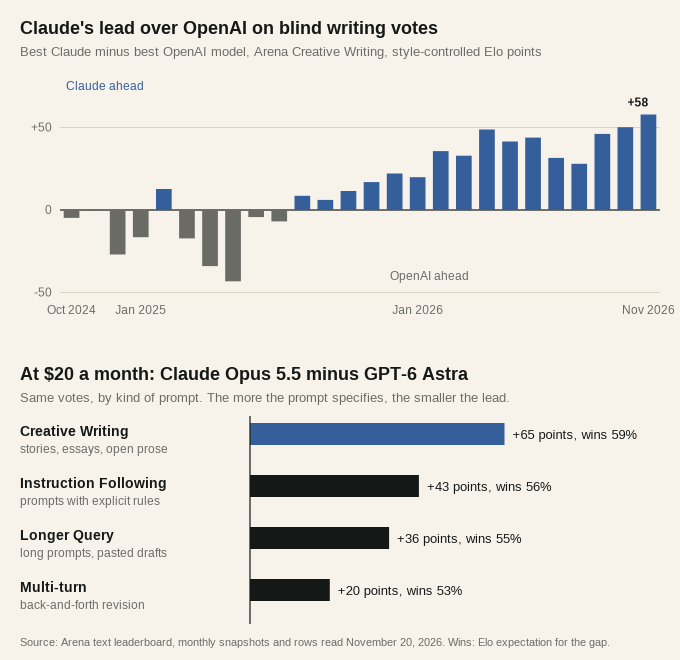
For most of the first year, OpenAI was ahead. In May 2025, ChatGPT's own model, chatgpt-4o-latest, led Claude 3.7 Sonnet by 43 style-controlled points. Claude briefly led in February 2025, fell back, and then took the lead for good in August 2025 with Claude Opus 4.1. It has led on every snapshot since, and the lead has grown from 9 points to 58 in November 2026, Claude Fable 5.2 against GPT-5.6 Sol.
Without style control, the votes tell a louder version of the same story. ChatGPT's unadjusted lead in May 2025 was 84 points, about twice the adjusted figure. So roughly half of what made ChatGPT look like the better writer then was longer, more heavily formatted answers. It cuts both ways: in February 2026, Claude's raw lead of 66 points was 36 after style control.
That history explains a gap you'll notice when you search this question. On November 21, five of the seven web results on Google's first page in the US were published before August 2025. They describe a race that has since flipped. Any writing comparison has a shelf life of a few months, so check the date on any verdict, including ours.
A looser brief gives Claude a bigger lead
Look at the four categories again. Claude's lead is largest where the prompt leaves the most open, and smallest where it pins the answer down.
A Creative Writing prompt asks for a story, a poem, or an essay and leaves tone, structure, and word choice to the model. So the voter is judging taste. An Instruction Following prompt states rules, such as a word limit, a format, or things to leave out, and the voter can check whether each answer obeyed. When both answers obey, there's less left to separate them. Multi-turn votes judge conversations of more than one turn, where the user can correct course, and there the two models are tied.
We'll call this the brief effect: the more your prompt specifies, the less the app you picked matters. Claude's lead falls from 65 points to 43 when the prompt carries rules, and to a tie when you revise over several turns.
Two explanations don't fit the data. Length and formatting can't account for it, because style control has already taken them out. And it isn't a quirk of GPT-6 Astra: GPT-6.1 Sol shows the same shape, 66 points behind Opus 5.5 on Creative Writing and 32 on Instruction Following. What we can't rule out is the mix of prompts and voters. Arena's voters write their own prompts, and a category label is a coarse sort. So treat the brief effect as a pattern in these votes, not a law of writing.
It still gives you a practical rule. If you write open-ended work in your own voice, the model's taste does most of the work, and that's where Claude leads. If you write to a template, your template does most of the work, and either app will follow it.
Which is better for each kind of writing
Arena's categories don't map onto writing jobs one to one, so this table pairs each common job with the vote closest to it. It's our mapping, and it's the table that decides the pick.
| Writing job | Closest blind vote | Claude Pro's lead over ChatGPT Plus | Our pick |
|---|---|---|---|
| Essays, fiction, personal posts, speeches | Creative Writing | 65 points | Claude |
| Ad copy, product descriptions, emails written to a template | Instruction Following | 43 points | Claude, by less. Either works with a strict brief |
| Editing or rewriting a long draft you paste in | Longer Query | 36 points | Claude |
| Revising a piece over several rounds of feedback | Multi-turn | 20 points, a tie | Either |
| Opening lines, jokes, plain explanations | Kaggle's short-form arenas | Too few votes to tell | No pick yet |
For fiction specifically, the best AI for fiction page ranks every model on the creative-writing evidence we track. If you'd consider a third app, Gemini 4 Argon on Google AI Pro scores 1,520 on Creative Writing, level with Claude Opus 5.5, and leads it on Multi-turn. Our best AI for writing post covers Gemini's picks.
Short-form writing is the one place OpenAI might lead. On Kaggle's Opening Lines Arena, where people vote on the first lines of novels, six of the top seven entries are OpenAI configurations and Claude Opus 5.5 places 12th of 17. But each entry has 5 to 14 votes, with margins of 177 to 251 points, so every row overlaps every other. Kaggle's Joke Arena has more votes and still can't separate GPT-6 Astra (1,559 ±99) from Claude Opus 5.5 (1,510 ±102). If ChatGPT is better at short hooks, as Google's AI Overview claims, the public votes don't show it yet.
Claude's free plan holds level with ChatGPT Plus
Claude Free runs Sonnet and Haiku, and Claude Sonnet 5.5 scores 1,460 on Creative Writing. GPT-6 Astra on the $20 ChatGPT Plus plan scores 1,451. Their margins are about 11 points each, so the two are level: by the blind votes, Claude's free tier writes as well as ChatGPT's paid one.
What you give up on Claude Free is volume. Anthropic's pricing page lists limited usage every five hours and every week on Free and doesn't publish the number. For a few drafts a day that's usually enough, and for a writer working all day it's the reason to pay.
ChatGPT's free plan is harder to score. OpenAI's pricing page lists unlimited text chats with "GPT-6" on Free without saying which GPT-6 model. Only one OpenAI model is named on ChatGPT Free: GPT-6 Luna, for the Codex coding agent, at 1,409 on Creative Writing. We don't assume the chat window runs Luna.
That caveat applies one tier up too. OpenAI's plan page lists Plus models mostly by where they run, in Codex or ChatGPT Work, not the chat window. It doesn't change the verdict, though. Every GPT-6 model on the board scores between 1,409 (Luna) and 1,469 (GPT-6.2 Astra), so whichever one your chat box runs, Claude Opus 5.5 leads it by at least 47 points. GPT-6.2 Astra launched on November 17 and has only 413 votes so far, with a margin of ±30.
What the blind votes can't tell you
Each Arena vote compares two answers to one prompt, read once. That's a fair test of first impressions, and it doesn't measure whether a model keeps your voice across a 3,000-word piece, gets facts right, or stops inventing quotes. Winning the opening paragraph doesn't stop a model drifting by page three.
Voters are also not you. They write their own prompts and reward what reads well to them. If your work has a house style, a legal reviewer, or a reader with specific taste, the votes are a starting point.
ChatGPT and Claude also differ in ways no writing score covers. ChatGPT Free lists image creation, and Claude Free doesn't list deep research, which starts on Pro. We compared those tools in the best AI chatbot, and the ChatGPT vs Claude comparison puts every benchmark side by side. For code, the answer is different again: see ChatGPT or Claude for coding.
Test it on your own brief in 20 minutes
The votes tell you where to start. Your own work tells you which app to keep. This test takes about 20 minutes and uses the free plans if you don't pay for either:
- Pick five real briefs from your last month of work: two open-ended (an essay, a post in your voice), two with strict rules (a product description, a templated email), and one piece you'd normally revise.
- Send each brief, word for word, to both apps. For the revision piece, give the same two rounds of feedback to each.
- Paste each pair into a document as A and B, shuffled, so you can't tell which app wrote which.
- Ask a colleague, or yourself the next morning, to pick the better one in each pair and note why.
- Count the wins by kind of brief.
If Claude wins the open-ended pairs and the rule-bound ones split, you've reproduced the brief effect on your own work, and you know where a second subscription pays. If ChatGPT wins your open-ended pairs, trust your result over the votes.
Watch GPT-6.2 Astra's Creative Writing score as its votes grow past a few thousand. If it holds near 1,469, Claude's lead at the $20 tier shrinks from 65 points to under 50.
Frequently asked questions
01Is Claude better than ChatGPT for essay writing?
On blind votes, yes. Arena's Creative Writing category covers open-ended prose such as essays and stories, and on November 20, 2026 Claude Opus 5.5 scored 1,516 against 1,451 for GPT-6 Astra. For a graded academic essay, the votes say nothing about citations or accuracy, so check every source either app gives you.
02Is Claude or ChatGPT better for resume writing?
No public test scores resumes directly. A resume is rule-bound writing: fixed sections, a length limit, and facts you supply. The closest vote, Instruction Following, favors Claude Opus 5.5 by 43 points over GPT-6 Astra, a smaller lead than on open prose. Either app works if your prompt lists the rules.
03Is the free version of Claude good for writing?
Yes, by the votes. Claude Free runs Sonnet and Haiku, and Claude Sonnet 5.5 scored 1,460 on Arena's Creative Writing board on November 20, 2026, level with GPT-6 Astra on ChatGPT Plus at 1,451. The limit is how much you can use it: Anthropic doesn't publish the Free allowance.
04Should I switch from ChatGPT to Claude for writing?
Switch if most of your writing is open-ended, such as essays, fiction, or posts in your own voice, where Claude's lead is largest. If you mostly write to templates with strict rules, the gain is smaller and ChatGPT's other tools may matter more. Run the same five briefs through both before paying for a second plan.
External sources linked in this article
2- 01Arenaarena.ai
- 02style-control methodlmsys.org