
MCP and an API differ in who writes the request. With an API, you write it when you build. With MCP, a model writes it while it works.
You pay for that in tokens.
On November 25, 2026 we asked our own data service one question both ways. Both answers matched, byte for byte. Through MCP, though, the model had read 7,031 tokens before anyone asked anything, three times the size of the answer.
So where does that overhead come from, when is it worth paying, and how do you cut it?
One question gives the same answer over REST and MCP
BenchLM Data serves the rankings and prices on this site through a REST API and an MCP server. Both run the same queries against the same data, so it's a clean place to compare the two. Our test question: which models have the best coding score at $3 or less per million output tokens?
Over REST, that's one line a developer writes after reading the docs:
curl 'https://data.benchlm.ai/v1/recommend?surface=coding&maxOutputPrice=3&limit=5' \
  -H 'Authorization: Bearer YOUR_DATA_KEY'
Over MCP, nobody writes that line. A person types the question into Claude, ChatGPT, or Codex. From the tools the server offers, the model picks benchlm_recommend and writes the arguments itself:
{ "name": "benchlm_recommend", "arguments": { "surface": "coding", "maxOutputPrice": 3, "limit": 5 } }
We ran both against the Data service's own code, on the November 23 data, and compared what came back. They were identical: 7,745 bytes of JSON, five models with scores, ranks, and prices. MiniMax M3.1 Flash led at a coding score of 77.6, priced at $0.15 in and $0.60 out per million tokens. Each path used one read from the same monthly allowance.
So the data doesn't differ, and the service charges the same. Everything around the answer does.
MCP costs 7,031 tokens before the first question
Before a model can call a tool, it has to read about it. When an app connects to an MCP server, it fetches the server's tool list, and in most apps those definitions go into the model's context for the whole conversation. Each one is a name, a description of when to use it, and a schema for its arguments.
Our server lists 28 tools. Counted with OpenAI's o200k_base tokenizer, their definitions come to 6,562 tokens, and the server's instructions add 469. That's 7,031 tokens in the conversation before a question arrives. After that, the model writes 24 tokens of arguments and reads a 2,330-token answer.
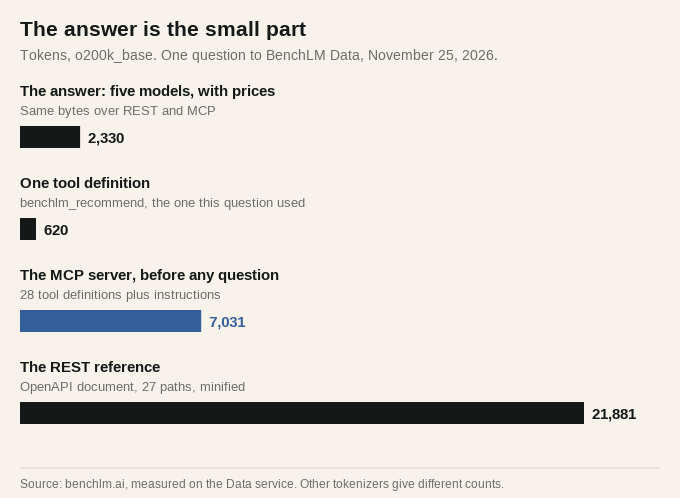
Through MCP, the first answer costs 9,385 tokens of context. Fetched by a script, the same answer costs the model nothing, because the model never sees the request. Your code reads the JSON and uses the fields it needs.
Is 7,031 tokens a lot? At $3 per million input tokens it's about two cents a conversation, and prompt caching cuts that on later turns. For one person asking questions in a chat app, it doesn't matter. For an agent that starts a thousand conversations a day, it's $21 a day spent on a menu, most of which the agent never orders from. Our question used one tool out of 28, and its definition is 620 tokens.
Two caveats on the numbers. Token counts depend on the tokenizer, so Claude or Gemini will count the same text a little differently. On the wire, MCP is also heavier than the context cost suggests: a tool result carries the answer twice, once as text and once as structured data, so the response was 16,492 bytes against REST's 7,745. Which copy the model reads is up to the app.
API docs cost a developer an afternoon, and a model 21,881 tokens
None of that overhead is waste. It's the price of the model doing a job a developer used to do.
To call an API, someone has to read its documentation, choose the right endpoint, and get the parameters right. Developers do that once, at a desk, and the reading never shows up on a bill. To let a model do it instead, you'd have to hand the model the same documentation. For our REST API that's the OpenAPI document: 27 paths, and 21,881 tokens once minified.
Seen that way, an MCP tool list is API documentation rewritten for a reader who pays by the word. Ours covers the same queries in 6,562 tokens, less than a third of the OpenAPI document, because every description was cut to what a model needs to choose a tool and fill in its arguments.
That gives a test you can reuse on any integration. Call it the author test: ask who writes the request.
If you write it, before the program runs, call the API. You already know the question, so nothing needs to be discovered, and code will ask it the same way every time.
If a model writes it, at run time, you need MCP or something like it. Nobody knows the question in advance, so the model has to see what it could ask. Those tokens buy the choice.
Where each one is the wrong choice
MCP is the wrong choice for anything on a schedule. Think of a model router that re-reads the coding ranking every hour, a nightly check for price changes, or a dashboard. Each asks a fixed question. Putting a model between the timer and the endpoint adds token cost and one more thing that can vary, since a model may pick a different tool or different arguments on a different day. Write the request once and call REST.
REST alone is the wrong choice when the person asking doesn't write code, or when the questions can't be listed ahead of time. "Which of these three models is cheapest for our support bot, and did any of them change price this month?" takes three or four calls, chosen as the answers come in. Nobody builds an endpoint for that. With the tools in front of it, a model works it out.
One more case gets lost in the usual "MCP for agents, API for apps" advice: an agent that does one narrow job. It needs a model in the loop, but it doesn't need 28 tools. That's where the tool list is worth trimming.
MCP vs function calling: both cost context, so trim the tool list
Function calling and MCP aren't alternatives. Function calling is the model's side: it replies with a tool name and arguments instead of prose. MCP is the delivery side: a standard way for an app to fetch tool definitions from a server and run the calls. Each MCP tool reaches the model as a function definition, which is why the token math is the same for both.
That also tells you where the savings are. Three things reduce the fixed cost, and we'd try them in this order.
- Offer fewer tools. Most clients let you allow only some of a server's tools. In Codex, the
enabled_toolskey inconfig.tomlis that allow list. Four of our tools cover picking, comparing, and pricing models, and their definitions total 1,198 tokens against 6,562 for all 28. The Codex setup page has the config. - Let the client load tools on demand. Claude Code's tool search, which its documentation says is on by default, gives the model tool names first and loads a definition when the model asks for it. With that, the fixed cost falls toward the one definition you use.
- Move the fixed question to code. If an agent asks the same thing at the start of every run, fetch it over REST before the model starts and put only the rows it needs in the prompt.
Your own server's menu is one request away, so measure it
You can run this measurement on any MCP server in a few minutes, and it's worth doing before you connect one to an agent that runs all day.
- Ask the server for its tool list. It's one JSON-RPC request with the method
tools/list. - Count the tokens in the response with your model's tokenizer. That's the fixed cost per conversation.
- Make one real call and count the answer. If the tool list is several times larger than a typical answer, as ours is, trim it or defer it.
- Then apply the author test to each job. Any request you could have written yourself belongs in code.
Our own numbers come from tools/list and one benchlm_recommend call, and they'll move as we add tools. We watch the ratio: 7,031 tokens of menu to 2,330 of answer. Both paths are on a free Data account, with the same 1,000 reads a month, if you'd like to check our math against your own tokenizer.
Frequently asked questions
01Does MCP replace REST APIs?
No. An MCP server usually sits in front of an API and calls it for the model. Ours does: the MCP tool and the REST path run the same query and return the same JSON. MCP adds descriptions a model can read and a standard way for AI apps to connect. Scripts, dashboards, and scheduled jobs still call the API directly.
02What is the difference between MCP and function calling?
Function calling is how a model asks for a tool: it returns a tool name and arguments instead of text. MCP is how the tool gets there. It's a standard for an app to fetch tool definitions from a server and run the calls. An MCP tool reaches the model as a function definition, so both cost context tokens.
03Do MCP calls cost more than API calls?
At the service, not here: one MCP call and one REST request each count as one read on BenchLM Data. The extra cost is in the model's context. On November 25, 2026 the tool list and instructions measured 7,031 tokens per conversation, and the answer itself 2,330. A script calling REST spends no model tokens.
04When should I use an API instead of MCP?
Use the API when you know the request before the program runs: a nightly price check, a router that reads the same ranking every hour, a dashboard. Code handles those at no token cost and gives the same result every time. Use MCP when a person or an agent decides what to ask in the middle of a conversation.