We generated 24 marketing drafts from one fictional product ledger: a fixed list of approved facts, forbidden claims, and open unknowns. Source-ledger prompts met 11 of 12 fact-and-format contracts. Rough prompts met 3 of 12. Both totals follow a correction to our automated checks, disclosed below.
The outcome was not better marketing in the abstract. It was a draft that stayed inside approved facts and arrived in the requested shape.
That gives an editor usable raw material. It does not give the draft permission to publish.
Most pages targeting ChatGPT prompts for marketing compete on the number of prompts they list. We held one evidence set constant instead. The test asked whether a landing hero, launch email, LinkedIn post, and positioning statement could use the same four facts without inventing the missing story.
One ledger has to serve four deliverables
Northstar Cost Lens is a fictional API cost dashboard. The model received a closed source ledger:
| Ledger section | Frozen content |
|---|---|
| Audience | Engineering leaders evaluating model and environment spend |
| Approved facts | Breaks API spend down by model and environment; supports CSV export; supports saved filters; launches July 30 |
| Prohibited claims | Customer adoption, savings, performance, reliability, testimonials, awards, or market leadership |
| Unknowns | Price, trial availability, integration count, and historical customer results |
| Required action | “Open the dashboard” |
| Human boundary | Tone, usefulness, and brand fit still require an editor |
The ledger came before instructions such as direct, exciting, or high-converting. A tone adjective cannot tell the model whether a savings claim is true. An evidence boundary can tell it not to make one.
We also gave each deliverable its own format rules. The hero needed one headline, one short subhead, three proof bullets, and one call to action. The email needed one subject, no more than 160 body words, and the same action. The LinkedIn post had to stay under 120 words without hashtags. The positioning statement needed one sentence, three evidence bullets, and the action.
Every case ran three times with the rough request and three times with the source-ledger prompt. The route was openai/gpt-5.6-luna; OpenRouter returned Azure for all 24 completions. Temperature was omitted, reasoning was disabled, and no repair turn followed a failed check. This was an API test, not a test of the consumer ChatGPT interface.
Twelve drafts make the missing decisions visible
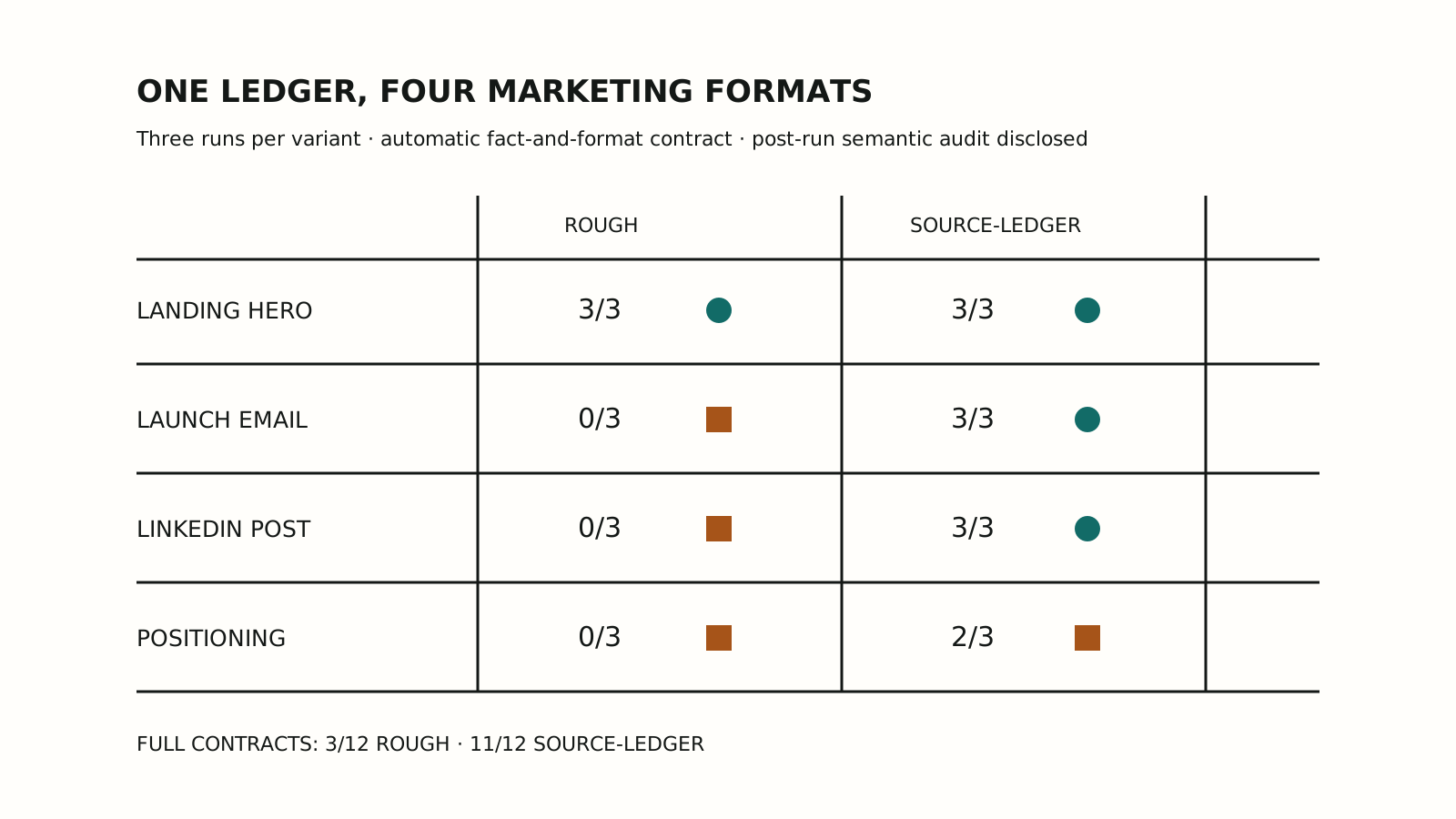
| Deliverable | Rough prompt fully passed | Source-ledger prompt fully passed |
|---|---|---|
| Landing-page hero | 3/3 | 3/3 |
| Launch email | 0/3 | 3/3 |
| LinkedIn launch post | 0/3 | 3/3 |
| Positioning statement | 0/3 | 2/3 |
| Total | 3/12 | 11/12 |
Those totals use corrected checks applied after the run. The raw embedded matcher counted 2/12 rough and 7/12 revised outputs as full passes because it missed equivalent phrases such as “Launching July 30,” “saved views,” and “export cost data as CSV.” We corrected those string checks without changing prompts, outputs, requirements, or model calls.
That correction was not preregistered. The raw 24-draft artifact preserves the original embedded results, and the frozen fixture preserves the ledger and contracts. Both are available without an email form.
The one revised miss was a positioning statement that omitted the exact call to action. The prompt did not guarantee compliance; it made the remaining failure visible.
The rough prompts wrote a story the ledger does not hold
The rough launch-email prompt contained one instruction:
Write an exciting product launch email for Northstar Cost Lens.
The model knew the product name because it also received the ledger as source input, but the request did not tell it to use only that ledger or to honor a fixed shape. One rough draft introduced development, staging, and production comparisons. Another turned CSV export into “reporting and collaboration.” The source material supported neither claim.
The rough LinkedIn prompts also added the familiar furniture of launch copy: budget conversations, deeper reporting, disconnected views, FinOps hashtags, and claims of clarity. These additions sound plausible because they are common outcomes of a cost dashboard. Plausibility is precisely the problem. The ledger did not establish them.
The source-ledger LinkedIn prompt produced this passing draft:
Meet Northstar Cost Lens, a dashboard for evaluating model and environment spend. Launching July 30, it breaks API spend down by model and environment, supports saved filters, and lets you export data as CSV. Open the dashboard
It is factual, short, and not especially memorable.
That is a better starting failure. An editor can improve rhythm and emphasis while seeing the boundary. Removing an invented benefit from polished copy requires tracing which other sentences depend on it.
A marketing prompt is an evidence contract
The source-ledger prompt separated five things that rough marketing requests usually blend:
Deliverable
Launch email

Format
One subject line, a body of at most 160 words, and one call to action.

Approved facts
- Breaks API spend down by model and environment.
- Supports CSV export.
- Supports saved filters.
- Launch date is July 30.

Unknowns
- Price.
- Trial availability.
- Number of integrations.
- Historical customer results.

Rule
Treat every unknown as unavailable. Do not infer a benefit, proof point,
comparison, price, or customer result that the approved facts do not state.
Use “Open the dashboard” exactly once.
The useful move is not “make the prompt detailed.” It is “make the evidence inspectable.” Facts say what may enter the draft. Unknowns stop the model from completing a familiar product narrative. The output contract says what the editor should receive.
The AI Prompt Generator can build this structure from a product brief, and the AI Prompt Optimizer can retrofit it onto a rough request you already have — but neither returns finished marketing copy. The target model still needs the source ledger, and its draft still needs factual, editorial, accessibility, and legal review.
Better boundaries produced plainer copy, not better conversion
The source-ledger variants used fewer completion tokens and cost less in this run: $0.008352 in total versus $0.011679 for the rough prompts. The rough outputs often spent tokens on greetings, preview text, sign-offs, hashtags, disclaimers, and extra benefit language that the format did not request.
That is an observation from 24 completions, not a pricing rule. A longer input prompt can easily cost more on another task or model. Current API pricing should inform the route, but editorial rework is the larger hidden cost in this workflow.
The stricter prompts also produced flatter prose. They repeated the product name, listed approved facts mechanically, and sometimes labeled sections as “Body” and “Call to action.” Automatic fact checks rewarded those choices because distinctiveness was outside the contract.
No score in this study says the revised drafts would convert better.
That honest limit changes the workflow. First get a fact-bounded draft in the required format. Then let an editor choose the strongest supportable angle, remove mechanical phrasing, and test the result with the audience. If the editor adds a new benefit, add its source to the ledger before the next generation.
The prompt optimization method treats that edit as a controlled loop: preserve the facts, define the artifact, test representative cases, and change the smallest instruction behind each failure. For marketing work, the source ledger is the part that prevents optimization from becoming decoration.
Unknown is a valid marketing input
Most product briefs are incomplete. Price may be unsettled. A trial may not exist. Customer evidence may still be under review. Hiding those gaps does not make a model cautious; it gives the model room to infer the most familiar answer.
Mark the gaps.
The usable outcome of a marketing prompt is not a draft that sounds finished. It is a draft whose claims can be traced, whose missing evidence remains missing, and whose shape gives an editor a focused starting point. Tone comes after that contract because persuasion cannot rescue a sentence the company cannot prove.
Reader questions
Frequently asked questions
01What should a ChatGPT marketing prompt include?
Include the deliverable, audience, approved facts, prohibited claims, unknowns, format, length, call to action, and review boundary. Tone belongs in the prompt, but it should come after the evidence contract. The model should know which statements it may use and which details it must leave unresolved.
02How do I stop ChatGPT from inventing product claims?
Give it a closed source ledger and state that anything absent is unknown. Name forbidden claim categories such as savings, customer counts, performance, testimonials, and market leadership. Then check the draft sentence by sentence against the ledger. Prompt wording reduces risk; it cannot replace factual and legal review.
03Are longer marketing prompts always better?
No. Useful length closes a decision about evidence, audience, shape, or review. Generic persuasion advice can add words while encouraging unsupported benefits. In this run, the source-ledger prompts were longer because they carried the facts and boundaries needed to judge the draft, not because length was the objective.
04Can a factually correct AI marketing draft be published immediately?
No. The automatic contract checked facts, exclusions, length, structure, and call-to-action placement. It did not judge whether the copy was distinctive, persuasive, accessible, on-brand, or legally sufficient. Several passing drafts were flat. A human editor still needs to decide what is worth saying and how to say it.
Share or save