
"Write a report" asks for a category. "Write a six-row incident table from the supplied logs, keep unknown root causes unknown, and flag any row missing an owner" asks for work a reviewer can inspect.
We found the reliable structure names the finished work first, then context, sources, limits, required shape, and definition of done. Use only the parts that close a real decision.
That method produced more accepted outputs in our 12-case run. Five noncoding cases tied. One revised launch prompt got worse. The goal is not a long prompt. It is work that arrives with the right facts, shape, and review boundary.
Done is the first decision
The second version of that assignment does three jobs before the model writes a word. It names the artifact, protects the evidence boundary, and exposes missing fields. Tone and persona can come later if they change the result.
Our prompt-outcome run held 12 synthetic tasks and their inputs constant. Across the 10 noncoding cases, rough prompts fully passed 20 of 30 runs and revised prompts passed 28 of 30. The largest gains came from missing citations, table fields, action-item uncertainty, and protected executive-summary facts. The complete before-and-after article keeps the five ties and one regression beside those wins.
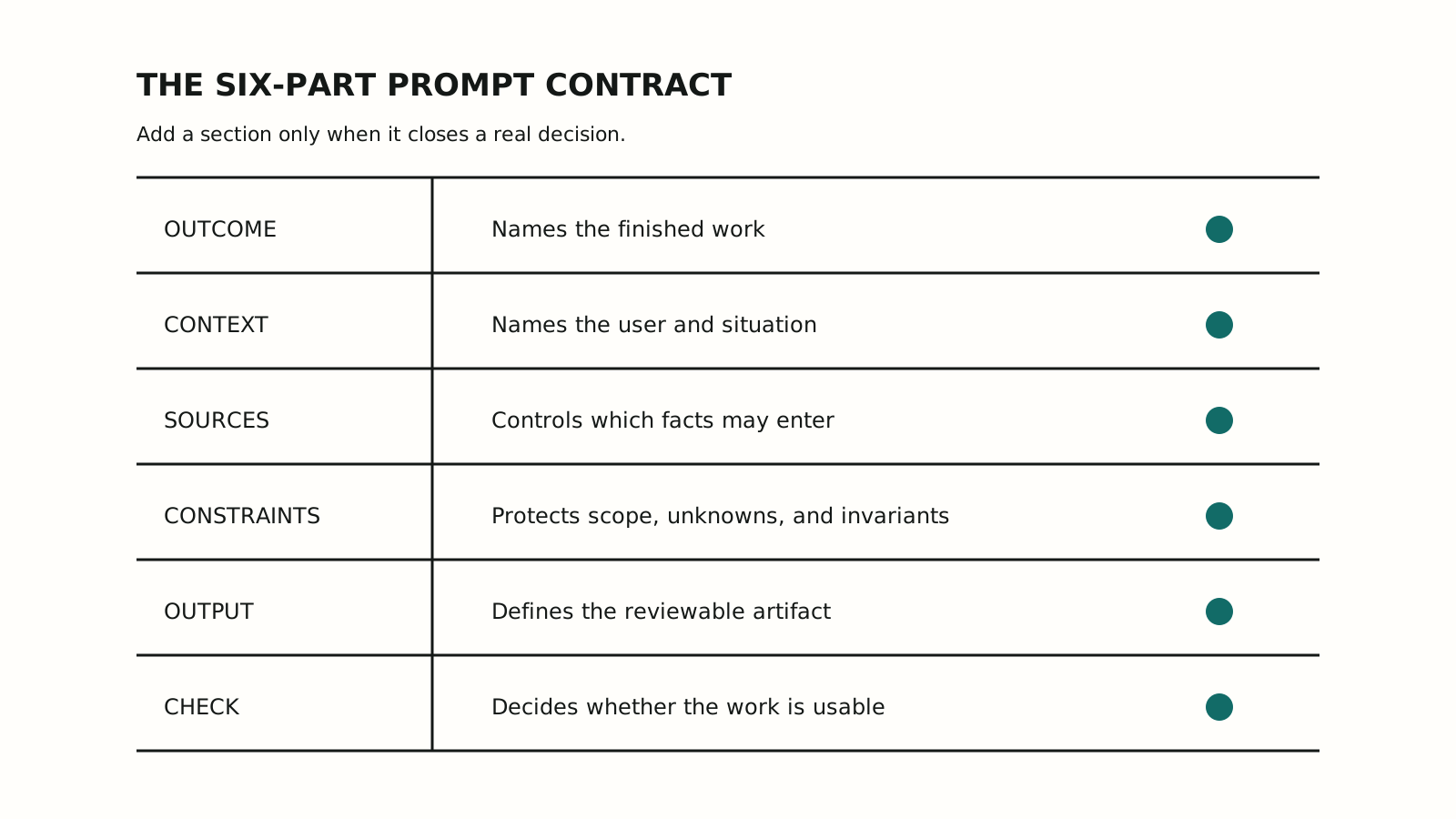
| Part | Decision it closes | Example |
|---|---|---|
| Outcome | What finished work should exist | A provider-policy comparison and recommendation |
| Context | Who will use it and why | A technical buyer choosing for a regulated workload |
| Source material | Which facts control the answer | Two dated provider policy documents |
| Constraints | What must remain bounded | No outside knowledge; unstated values stay unknown |
| Output contract | What the reviewer should receive | Four-row table plus a recommendation |
| Acceptance check | What decides whether it is usable | Every claim cites a source ID and section |
These parts can live in one paragraph, a structured form, or a repository instruction file. The labels are scaffolding. The closed decisions are the product.
One policy comparison makes the contract visible
Suppose the task is to compare two AI provider privacy policies. The rough version is:
Compare these AI provider privacy policies and recommend one.
The model can produce fluent prose from that request, but it must invent the comparison frame. Does retention matter more than regional processing? Should it cite a paragraph, link, or nothing? Which workload controls the recommendation? What happens when one policy is silent?
The revised assignment closes those decisions:
Outcome
Compare Provider A and Provider B for a regulated API workload, then recommend
one under the stated assumption.

Sources
Use only the two supplied policy documents.

Criteria
- Data retention
- Training use
- Regional processing
- Enterprise controls

Constraints
Cite the source ID and section heading for every policy claim. Keep anything
the policies do not state as unknown.

Output
Return a four-row comparison table followed by a recommendation of at most
120 words.

Acceptance check
Every criterion appears, every policy statement has a citation, unknowns stay
unknown, and the recommendation names the workload assumption.
In the frozen run, the rough prompt produced 0/3 fully accepted outputs. The revised version produced 3/3. The improvement did not come from phrases such as “be comprehensive.” It came from supplying the missing decision and a citation receipt.
Use one copyable contract
Start with this template:
Outcome
[Name the finished work and the decision it should support.]

Context
[Name the audience, operating situation, and relevant prior state.]

Source material
[Provide or identify the facts, files, data, examples, or policies that
control the answer.]

Constraints
[State what must not change, what may not be inferred, and what remains
unknown.]

Output contract
[Define the sections, fields, schema, length, tone, and completion receipt.]

Acceptance check
[List the observable conditions that make the result usable.]
Do not fill every field with generic advice. “Be accurate” does not define accuracy. “Use a professional tone” does not identify the audience. “Act as a world-class expert” has never supplied a missing fact.
A short prompt is enough when the environment already closes the decisions. In our invoice extraction case, the source input listed the exact JSON keys and the rule for missing values. Both variants passed 3/3. Repeating the schema in more elaborate prose would not improve the observed outcome.
Three jobs need different evidence, not different adjectives
Marketing prompts need a source ledger. The model should see approved facts, prohibited claim categories, unresolved details, the audience, and the format. In the factual-marketing run, source-ledger prompts met 11 of 12 fact-and-format contracts; rough prompts met 3 of 12. The stricter drafts were safer raw material, not finished campaign copy. The marketing lab shows the flat prose and remaining human-review boundary.
Coding prompts need repository evidence. Name the behavior, relevant files, invariants, allowed paths, and commands. Both prompt variants passed all 12 repository runs in our coding lab because the harness supplied strong tests and scope controls to both. The revised prompts mainly reduced unrelated code under an unblinded review. The coding lab explains why passing tests did not settle the merge decision.
Structured extraction needs a schema and an uncertainty rule. For invoice JSON, define every key, value type, and missing-value behavior. For meeting notes, define how to represent an absent owner or due date. A model should not turn an empty source field into an educated guess merely because the output table expects a value.
The prompt format changes because the acceptance evidence changes.
More detail can damage the result
The launch-announcement test began with a source containing four approved facts and three prohibited claim categories. The revised prompt repeated those categories and told the model to mark unsupported claims unknown. Two of three outputs responded by printing the prohibited categories as disclaimers.
The prompt became more explicit and the work became less publishable.
That regression provides a practical editing rule: phrase constraints as output behavior. “Do not mention savings percentages, including to deny them” is safer than “Savings percentages are unknown.” The first controls the artifact. The second gives the model language it can copy.
Long contexts can fail in a similar way. A repository dump may contain an old interface beside the new one. Three research papers may measure incompatible outcomes. More input helps only when the prompt labels which evidence controls the decision and which material must stay separate.
The prompt is a small experiment
Use the AI Prompt Generator when the task begins as a brief. Use the AI Prompt Optimizer when an existing instruction produced a recognizable failure. Then run a controlled loop:
- Choose a representative input.
- Freeze the acceptance conditions before revising.
- Run the original prompt more than once.
- Record full, partial, and failed work.
- Change one instruction attached to a failure.
- Rerun under the same model settings.
- Keep ties and regressions.
Do not infer accepted work from a copied prompt or a positive prompt vote. The target-model output still needs its own check. For code, that means repository commands and diff review. For marketing, it means factual and editorial review. For data, it means recalculating the result from the source.
Model and token choices belong to the experiment too. The Token Counter can expose how much source material the assignment carries, and current API pricing can help select routes for repeated runs. Neither number says whether the output is usable.
Stop adding words when the work survives. The finished prompt is not the longest version or the one with the most headings. It is the smallest instruction and evidence bundle that repeatedly produces accepted work on representative inputs.
If a rule does not protect a fact, decision, interface, shape, or check, remove it and rerun.
Reader questions
Frequently asked questions
01How do I write a good AI prompt?
Name the finished work first, then provide the context and source material required to produce it. Add constraints, an exact output contract, and a check that decides whether the result is usable. Test the prompt on representative inputs and revise the smallest instruction behind each failure.
02What is the best structure for an AI prompt?
A reliable default has six parts: outcome, context, source material, constraints, output contract, and acceptance check. The sections do not need those labels, and simple tasks may need only a sentence. The structure matters when it closes decisions the model would otherwise have to infer.
03Should I tell an AI model to act as an expert?
Only when the role changes an observable decision, vocabulary, or review standard. “Act as an expert” does not supply missing facts, define the output, or protect scope. Replace generic authority language with the exact audience, evidence, constraints, and acceptance criteria that an expert reviewer would actually use.
04How much context should an AI prompt include?
Include the context required to resolve the task, and no more. Relevant source documents, repository rules, examples, definitions, and unknowns usually matter. A large context dump can bury the assignment or introduce conflicting evidence, so label sources and state which material controls the answer.
05Why does a detailed AI prompt still fail?
Detail can repeat the wrong rule, conflict with the source, exceed the model's attention, or define a shape without protecting the facts. The model also varies between runs. Treat the first failure as evidence: inspect the unmet requirement, change one controlling instruction, and rerun the same input.
Share or save