
"Improve this prompt" can produce a longer instruction that looks professional while quietly changing the task.
We treat a prompt as better only when the target model follows the facts, constraints, and output format more reliably on representative inputs. Until that test runs, a clearer rewrite is still a hypothesis.
The working loop is plain: state the job, preserve the facts, define the output contract, run representative inputs, and revise the smallest instruction behind each failure.
If you already have a rough instruction, the AI Prompt Optimizer shows its rewrite as a diff. If you have only a goal, the AI prompt writer builds the first structured version.
The reviewable unit is not elegance. It is whether the prompt keeps the assignment intact and makes the target output easier to judge.
The five-stage loop is unromantic on purpose
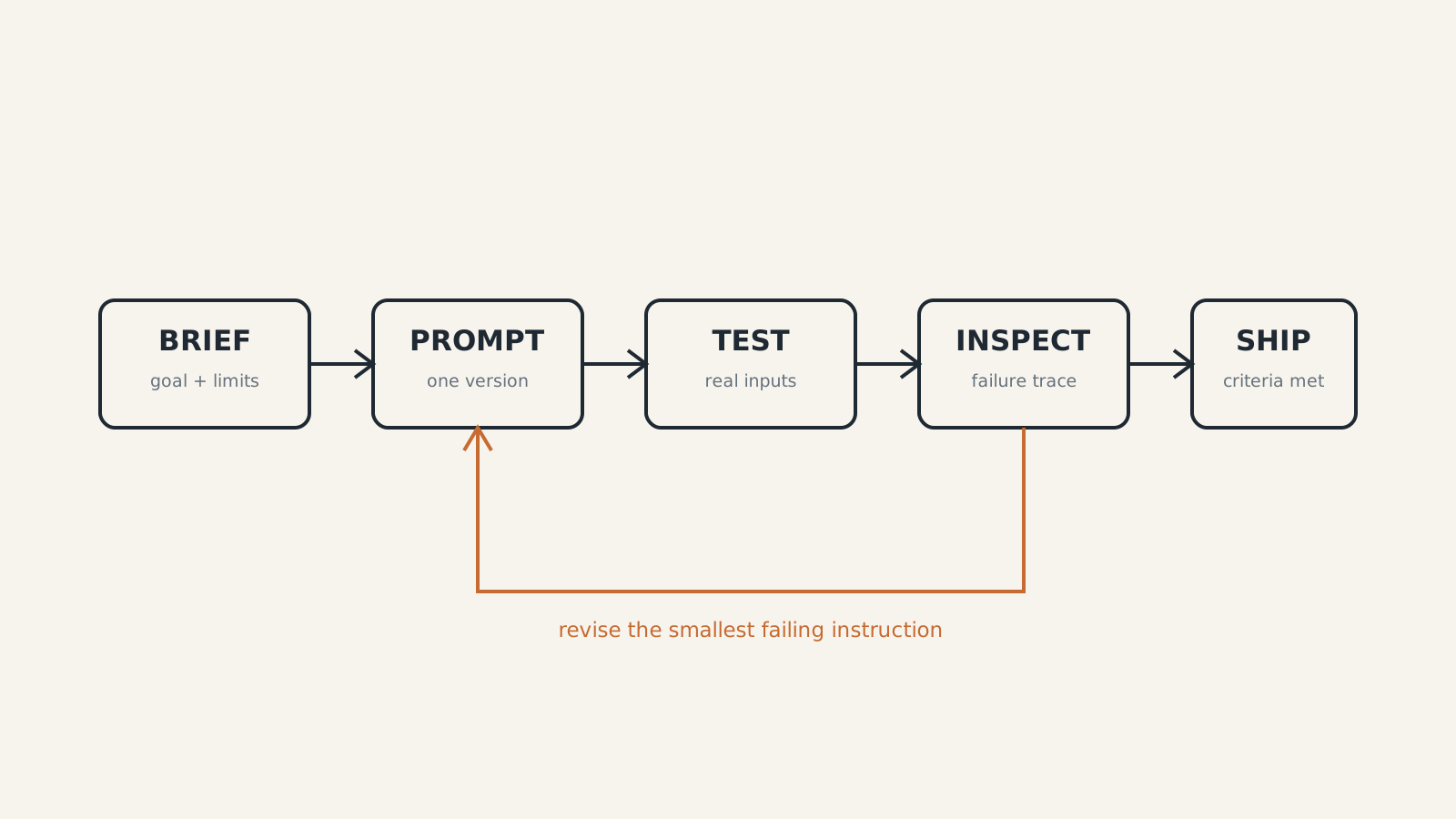
The loop has five stages:
- Brief: write the outcome, audience, usable context, constraints, and output format.
- Prompt: turn that brief into one instruction. Do not create variants yet.
- Test: run representative easy, typical, edge, and adversarial inputs.
- Inspect: connect each unacceptable output to the smallest instruction that failed.
- Ship or revise: keep the prompt only when it meets the acceptance criteria across the set.
The loop is intentionally unromantic. It gives every edit a reason and gives the next failure somewhere to land.
Start with an output contract
Most weak prompts do not fail because they lack a role such as “act as an expert.” They fail because the requested result is underspecified. The prompt names a topic but not the artifact, audience, evidence boundary, or format that would make the result usable.
A rough prompt looks like this:
Write a launch announcement for our API cost dashboard. Make it compelling and concise.
It identifies the task, but almost every operational choice remains open. Which audience? Which product facts? What can the model claim? How concise? What should the reader do next?
The same assignment with an output contract:
Write a launch announcement for engineering leaders evaluating API spend.
Use only these product facts: the dashboard breaks spend down by model and environment, supports CSV export, and saves filters. The launch date is July 30.
Produce a short headline followed by two paragraphs. Keep the full announcement under 180 words. Use a direct, technical tone. End with one call to action to open the dashboard. Do not invent customer results, savings, or adoption figures.
The second version is longer because each addition closes a decision the model should not make on its own. “Compelling” disappeared because it supplies no testable requirement. “Under 180 words,” “two paragraphs,” and “do not invent customer results” can each be checked.
The prompt optimizer is built around that receipt. It returns one rewrite, a clean view, a text diff, change explanations, and a list of preserved constraints. It does not run the announcement task or assign a decorative quality score.
Facts and instructions should stay separate
Models receive one stream of text. Prompts often contain several kinds of material: facts to rely on, instructions to follow, examples to imitate, and text to transform. Mixing them makes accidental instruction-following more likely and makes failures harder to diagnose.
A useful structure is:
| Section | What belongs there | Review question |
|---|---|---|
| Task | The job and intended result | Can one person describe success the same way? |
| Audience | Who will use or judge it | Does tone follow from a real reader? |
| Context | Facts, inputs, variables, examples | Can the model distinguish source material from commands? |
| Constraints | Limits, exclusions, safety boundaries | Are hard requirements explicit and preserved? |
| Output | Format, fields, length, ordering | Can the response be checked without interpretation? |
Not every prompt needs five headings. A one-line classification task may need only the input and allowed labels. Structure earns its keep when it separates material that would otherwise collide.
A rewrite should preserve the invariants
An optimizer can make a prompt worse by silently changing details that look small: a variable name, quoted text, code fence, required language, output key, safety boundary, or numerical limit. Those details are often the interface between the prompt and the rest of an application.
Before a rewrite, extract the invariants:
- facts the prompt may state;
- facts it must not invent;
- placeholders and variable names;
- required fields and ordering;
- length, tone, language, and formatting limits;
- examples whose labels or wording carry meaning;
- safety and policy boundaries.
Then compare the rewrite against the list. If a change cannot be explained without saying “this usually works better,” it has not earned its way into production.
One good answer does not prove the prompt
A single satisfying answer proves very little. Use a small set that represents the actual workload:
- an easy case with complete context;
- a typical case with ordinary ambiguity;
- an edge case near a length, formatting, or policy boundary;
- a sparse case where the model should expose missing information;
- an adversarial case containing text that should be treated as data, not a new instruction.
Define acceptance criteria before running the set. For the announcement example, they might be: all three product facts are present; the response stays below 180 words; no customer claim appears; the final sentence contains one call to action; and no placeholder remains.
When a case fails, change one instruction. If the model invents savings, strengthen the evidence boundary. If the output contains three calls to action, tighten the output contract. If the model omits CSV export, make the source facts an explicit required checklist. One edit preserves the failure trace. Five simultaneous edits erase it.
Manual and automatic routes fail differently
Prompt revision has two operating modes. Manual revision keeps a person close to the evidence and works well when the task is unusual, the consequences are high, or the acceptance criteria still need judgment. Automatic prompt optimization can help when the workload repeats and a stable evaluation set can catch regressions. A hybrid workflow uses automation to propose an edit, then requires a person to inspect the diff and the test results.
| Route | Best fit | Evidence required | Common failure |
|---|---|---|---|
| Manual revision | Low-volume, high-impact work | A recorded failure and the instruction changed to address it | Editors change several variables at once or optimize for prose style |
| Automatic optimizer | Repeated tasks with machine-checkable criteria | A fixed evaluation set, versioned prompts, and a rollback path | The optimizer improves a proxy while dropping a constraint |
| Hybrid review | Repeated work that still needs judgment | Automated proposals, human diff review, and regression tests | Approval becomes a formality instead of a real check |
We have not run a controlled manual-versus-automatic study on these tools, so there is no measured winner to report. A valid comparison would freeze the model version and settings, run the old and candidate prompts on the same representative inputs, score hard requirements before subjective quality, and keep every output with its pass or fail reason. Publish the test set, prompt versions, settings, and review rubric with any result.
The choice can also sit upstream of the prompt. If a failure persists across clear instructions and representative tests, compare the target models rather than polishing the same sentence again. Capability, latency, and API price can change the right answer before another rewrite does.
Model-specific wording is a last edit
ChatGPT, Claude, and Gemini do not behave identically, but most prompt quality comes from the shared contract above. A model-family setting is useful when it applies broadly reliable formatting or instruction patterns. It should not introduce fragile folklore or private syntax that the provider does not document.
Provider documentation supports the same evidence-first order. OpenAI's prompt engineering guide recommends precise instructions, relevant context, examples, and validation for current GPT models. Anthropic's prompt engineering overview starts with success criteria, empirical tests, and a draft prompt. Google's Gemini prompt design strategies call prompting iterative and document explicit constraints, output formats, examples, and model-specific settings.
A practical order:
- make the assignment model-neutral;
- test it on the target model;
- add a family-specific adjustment only for a failure you can reproduce;
- keep a portable baseline so the adjustment can be removed or compared later.
The generator and optimizer offer Any LLM, ChatGPT / OpenAI, Claude, and Gemini targets. Those choices tune the prompt for a model family. They do not identify the backend model used to produce the rewrite. Backend routing can change as quality and cost tests improve, so this guide does not pin a model ID. The interface and its current documentation are the source of truth for the live implementation.
The generator should hand off to the optimizer
The AI Prompt Generator starts from the brief. It returns one prompt, explains its design choices, and lists missing details that appear as bracketed placeholders. Resolve those unknowns before testing.
Its Refine button moves the generated text into the AI Prompt Optimizer. The handoff uses one-time browser session storage, removes the value after loading, and never places prompt text in the URL. The optimizer then exposes additions and removals for review.
Neither tool stores prompt text in the site database, logs, or analytics. Requests require OpenRouter's zero-data-retention routing and no-data-collection provider policy. OpenRouter's ZDR documentation explains that per-request enforcement restricts routing to endpoints with a zero-data-retention policy. The current allowance appears above each form. It is not hardcoded here because usage limits can change with operating cost.
The tools cannot prove the prompt works
The tools can improve structure and make a rewrite inspectable. They cannot establish that the final prompt is reliable in your application. That requires the target model, representative inputs, deterministic checks where possible, and human review where judgment remains part of the task.
The current implementation also uses one model to generate and optimize prompts. Agreement between a model and its own rewrite is not independent evaluation. A model-selection test is only a routing decision, not a substitute for workload-specific testing. Prompts involving regulated decisions, private data, or high-impact actions need controls beyond wording.
The next useful number is not a quality score on the rewrite. It is how many representative cases still fail after the smallest edit that could have prevented them.
Frequently asked questions
01What is prompt optimization?
It is a controlled rewrite of an instruction, judged against representative inputs and stated acceptance criteria. A useful pass makes the job, context, constraints, and output contract easier to check. The rewrite remains a hypothesis until you test it on the target model and the answers actually improve.
02How do I optimize a prompt for ChatGPT, Claude, or Gemini?
Write one model-neutral assignment first, then run it on the model you will actually use. Keep facts and constraints stable while changing one failing instruction at a time. Family-specific wording can help at the edges. Clear inputs, boundaries, and output requirements matter more than incantations that name the vendor.
03Should an optimized prompt be longer?
Only when the extra text removes a real ambiguity. Added length can bury the assignment, repeat constraints, and raise cost without improving the answer. Every section has to earn its place by supplying needed context, protecting a boundary, defining the output, or making a failure easier to diagnose.
04What is the difference between a prompt generator and a prompt optimizer?
A generator starts from a brief and writes a new instruction. An optimizer starts from an existing prompt and proposes a rewrite. Join them: generate from a structured brief, fill the visible unknowns, then optimize and inspect the diff before testing representative cases. Do not treat the rewrite as finished work until those cases pass.
External sources linked in this article
4- 01OpenAI's prompt engineering guidedevelopers.openai.com
- 02Anthropic's prompt engineering overviewplatform.claude.com
- 03Google's Gemini prompt design strategiesai.google.dev
- 04OpenRouter's ZDR documentationopenrouter.ai