Gemini 4 Neon became the second-highest-scoring model on the BenchLM leaderboard on our November 23 data, at 91.8. Four days earlier it was fourth, at 86.3.
Update, November 27, 2026: our November 27 refresh put GPT-6.2 Astra back in second at 91.7, with Neon third at 91.2, inside each other's published ranges. Claude Fable 5.2 still leads at 93.2. The rest of this issue uses the November 23 data, and the live order is on the leaderboard.
We know of no change to the model between those two dates. What changed was how many outside parties had tested the model: four independent evaluators on our November 19 data, and 17 on November 23.
This issue covers November 22 to 28, 2026, plus a few items from November 19 to 21 that arrived after the last issue's data. Scores and ranks come from our data on November 23. Prices are per million input and output tokens.
Gemini 4 Neon's first score was partly Gemini 4 Argon's
In the last issue we wrote that Neon's fourth place "could settle higher or lower as more boards report." It settled 5.5 points higher and passed GPT-6.2 Astra, which is now third at 90.8. Claude Fable 5.2 still leads at 93.3.
We can point to the cause of a move that large. When a model has fewer than 12 results, or fewer than two independent evaluators, our scoring doesn't start it from nothing. It starts from a relative whose position is well tested, and the new model's own results pull the score away from there as they come in. Our methodology page states the rule. For Neon the relative is Gemini 4 Argon, the tier below it, which scores 79.1.
On November 19, Neon had eight results, four from independent evaluators and four from Google. Those eight lifted it from Argon's level to 86.3. By November 23 it had 27 results, the starting point no longer applied, and Neon's own numbers put it at 91.8.
We'd call the day-one number a borrowed score. Part of it belongs to the model, and part is on loan from its family until enough tests arrive.
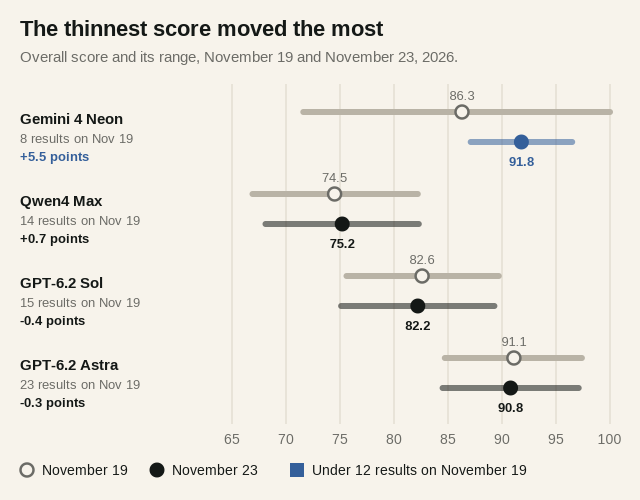
Compare the other models that launched that week. GPT-6.2 Astra had 23 results two days after launch, so it never borrowed, and its score moved 0.3 points. GPT-6.2 Sol had 15 and moved 0.4. Qwen4 Max had 14 and moved 0.7, enough to climb from 17th to 15th. Only the model under the 12-result line moved by more than a point.
Borrowed scores can miss in either direction. Neon turned out to be far stronger than Argon, so its early number was low, and a weak release from a strong family would start too high. That doubt shows in the range we publish with each score. Neon's ran from 71.6 to 100 on November 19, a 28-point spread, and it runs from 87.1 to 96.5 now. All four launch-week scores landed inside the ranges they carried on November 19.
Three of nine specialist leaderboards have a new leader
Narrower boards rest on fewer tests, so they moved more than the overall table did.
Fable 5.2 leads four of the nine boards and Gemini 4 Carbon three, with one each for Astra and Neon. Both the new search leader and the new documents leader carry our Estimated label, which means the rank is visible and the uncertainty is wider, so we'd expect those two to move again.
Neon's category scores filled in the same way. Its reasoning score went from 84.8 on one independent evaluator to 93.5 on three, two tenths behind Fable 5.2. It's third on our agentic board at 92.2 and fourth on coding at 90.3. On Bug Hunt Bench it now leads, fixing an average of 63 of 105 planted bugs at its highest reasoning setting against 62.7 for GPT-6.2 Astra.
On Humanity's First Exam and ShellBench, nearly right is wrong
Three benchmarks we added since the last issue share one rule: nearly right counts as wrong.
Google DeepMind's Humanity's First Exam asks 544 easy questions, such as counting objects in a picture or spotting a false premise, and runs each one six times. Answer a prompt correctly five times out of six and it keeps a third of its credit. Four out of six keeps 7%. DeepMind reports that the models it tested solve 98.9% to 100% of the task families at least once, yet the best score on the Kaggle board is GPT-6.2 Astra's 90.7%, with Neon at 85.6% and Claude Opus 5.5 at 70.0%. Intervals on that board run from 4.7 to 8.1 points either side, so neighbors are tied. Fable 5.2 isn't on it yet.
The OpenClaw Foundation's ShellBench hands an agent 100 everyday requests, each over a folder of one person's emails, calendars, and receipts. Each run passes only when it meets every correctness and safety criterion, so a right answer that leaks a private detail fails. GPT-6.1 Sol leads at 64.3%. It costs $2 and $10 and ranks eighth overall. Fable 5.2, first overall at $8 and $40, passes 54.3%. Their intervals overlap by about a point, which makes Sol's lead likely and not settled. Neither GPT-6.2 model has a row.
Eigent AI's AgenticRL-Bench has the lowest scores of the three. It sets 19 engineering tasks on reinforcement-learning training stacks, and GPT-6.1 Sol leads again by passing 22.8% of runs. Each model gets only 57 runs, so one run is worth 1.8 points and most gaps there are noise.
Our read is that these boards measure something the overall score mostly doesn't. Overall scores reward how hard a task a model can finish, and a strict board rewards how seldom the model slips on work it can already do. If your product sends the same kind of request ten thousand times a day, the second property is the one you pay for.
Surge AI's 14 leaderboards, which we added on November 21, grade in the same spirit. On DAYJOB: Tax an attempt passes only when it meets 95% of the rubric, and the best model, Fable 5.2, passes 15.6% of the time.
Inkling 2 Mini and GLM-5.4 are both looped transformers
Looped transformers run some of their layers more than once with the same weights. Such a model does more computing per token than its file size suggests, and the price is time.
Thinking Machines Lab released Inkling 2 Mini on November 20 under Apache 2.0. It has 24 layers and runs the middle 12 three times. Its model card counts 3.4 billion unique active parameters per token and 5.4 billion effective ones after the extra passes. At about 20GB, the checkpoint runs on an Apple Silicon machine with 32GB of memory. Hosted on the lab's Tinker service it costs $0.15 and $0.50. It ranks 69th at 56.0, and every one of its results so far was run by the lab.
Z.AI followed on November 23 with GLM-5.4, which runs 28 of GLM-5's layers twice. Z.AI calls it a 750-billion-parameter-scale model that performs like one of 2 to 3 trillion. It published no benchmark results to check that against, so the model has no rank. It also warns that GLM-5.4 can get caught in overly long thinking loops. Z.AI lists the API as coming soon. For now the model is in Z.ai Chat, ZCode, and the GLM Coding Plan, where it draws a third fewer credits per token than GLM-5.3.
Two launches don't make a trend. They do give outside evaluators an open-weight looped model to run, and Inkling 2 Mini's first independent result is the one we're waiting on.
From December 1, Gemini 4 Neon costs less than Gemini 4 Carbon
Google lists Carbon and Argon at $2 and $10 through November 30, then $4 and $20. Neon stays at $3 and $15. Take a workload of 100 million input and 20 million output tokens a month: Carbon goes from $400 to $800, and Neon costs $600.
Last issue that trade came with a warning, because Neon's score rested on four evaluators. It now ranks two places above Carbon on 17. Carbon keeps real advantages. It's ahead of Neon on coding, 91.8 to 90.3, it leads our cybersecurity, factuality, and finance boards, and 23 evaluators have tested it. If your work sits there, stay and pay. Otherwise test Neon on your own tasks before the December invoice. Both dates are on the Google API pricing page.
Four smaller changes came with dates or prices attached.
Anthropic deprecated Claude Opus 4.5 on November 23 and will retire it from its own API on January 22, 2027. It names Opus 5.5 as the replacement. Our Anthropic deprecations page has the model ID.
Google's deprecations page now lists the three Veo 3.1 preview IDs on the Gemini API as shut down, dated October 22. It also says gemini-omni-1.1-flash starts routing to 1.2 on December 3. We updated the video model guide with the routes that still take orders.
OpenAI put GPT-Live-1.1, its voice model, in the API on November 19 at $0.05 per active minute. It published safety tables and no capability benchmarks.
Baidu kept its promise on ERNIE 5.5 Flash Preview. Its weights appeared on Hugging Face on November 23 under Apache 2.0, two days ahead of the deadline it set. We checked the repository on November 27 and haven't moved the catalog row to open weight yet.
How to check a launch-week score
Whichever flagship launches next will have a rank on day one. Three checks tell you how much of it to believe.
- Count the results on the model page. Under 12, part of the score is borrowed from a relative.
- Read the range before the rank. With a spread wider than 15 points, the model can still move several places.
- Look at the categories you care about. When a category score rests on one evaluator, it's one test, however good it looks.
Then the dates. November 30 is the last day of $2 and $10 on Carbon and Argon, and of half-price Hy4 flash. December 3 is the gemini-omni-1.1-flash switch. After that we're watching for GLM-5.4's API price and for Fable 5.2's first row on Humanity's First Exam.
Release dates and sources for every model above are on model updates.
Frequently asked questions
01What was the biggest LLM news in late November 2026?
Gemini 4 Neon moved from fourth to second on the BenchLM leaderboard between November 19 and November 23, 2026, rising from 86.3 to 91.8 as its independent evaluators grew from four to 17. It passed GPT-6.2 Astra, third at 90.8 that day, and Claude Fable 5.2 led at 93.3. In our November 27 refresh Astra moved back to second at 91.7, with Neon third at 91.2.
02Why did Gemini 4 Neon's score rise 5.5 points without a new release?
A model with fewer than 12 results starts from the score of a well-tested relative, and its own results pull it away as they arrive. Neon had eight results on November 19 and started from Gemini 4 Argon's 79.1. By November 23 it had 27, and they put it at 91.8.
03What is Humanity's First Exam (HFE)?
Humanity's First Exam is a Google DeepMind benchmark of 544 simple text and image prompts that people get right almost every time. Each prompt runs six times, and a model loses most of the credit for one miss. GPT-6.2 Astra leads the Kaggle board at 90.7%, with Claude Opus 5.5 at 70.0%.